
Tree Cabling and Support Systems on Bainbridge Island, WA
When a tree has a codominant stem, a wide-angled fork, or a branch union that concerns you, tree cabling and support systems can be a practical option worth considering. Pine & Ponder Tree Service evaluates trees on Bainbridge Island and throughout Kitsap County to determine whether structural cabling is appropriate, then installs support cables for trees that are good candidates for the work.
What We Do
Tree Cabling Service for Codominant and Multi-Stem Trees
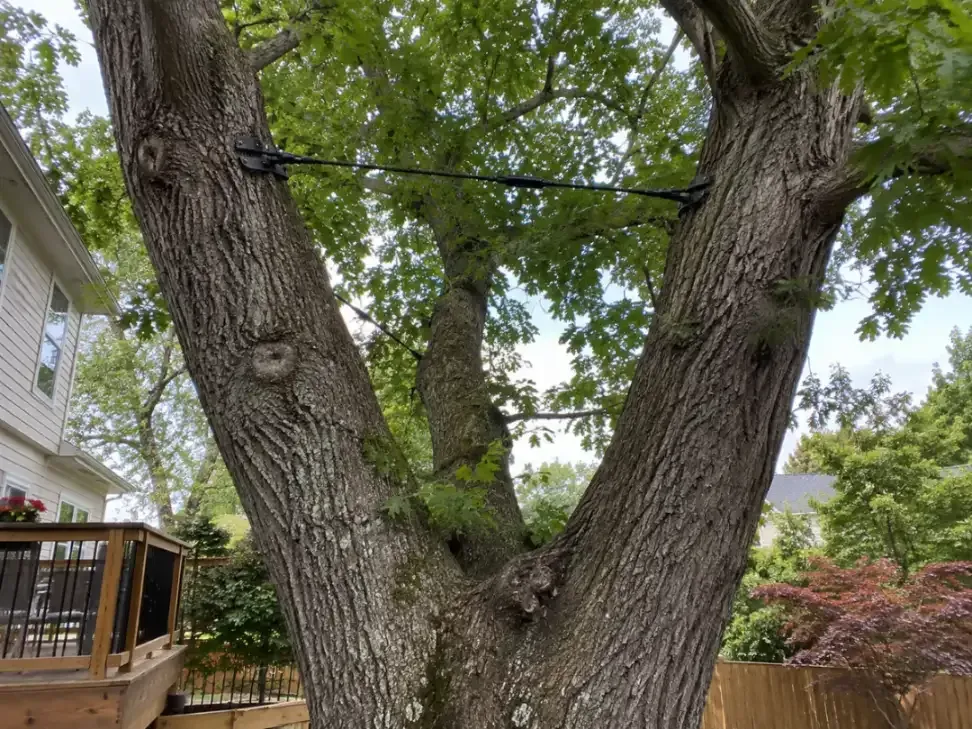
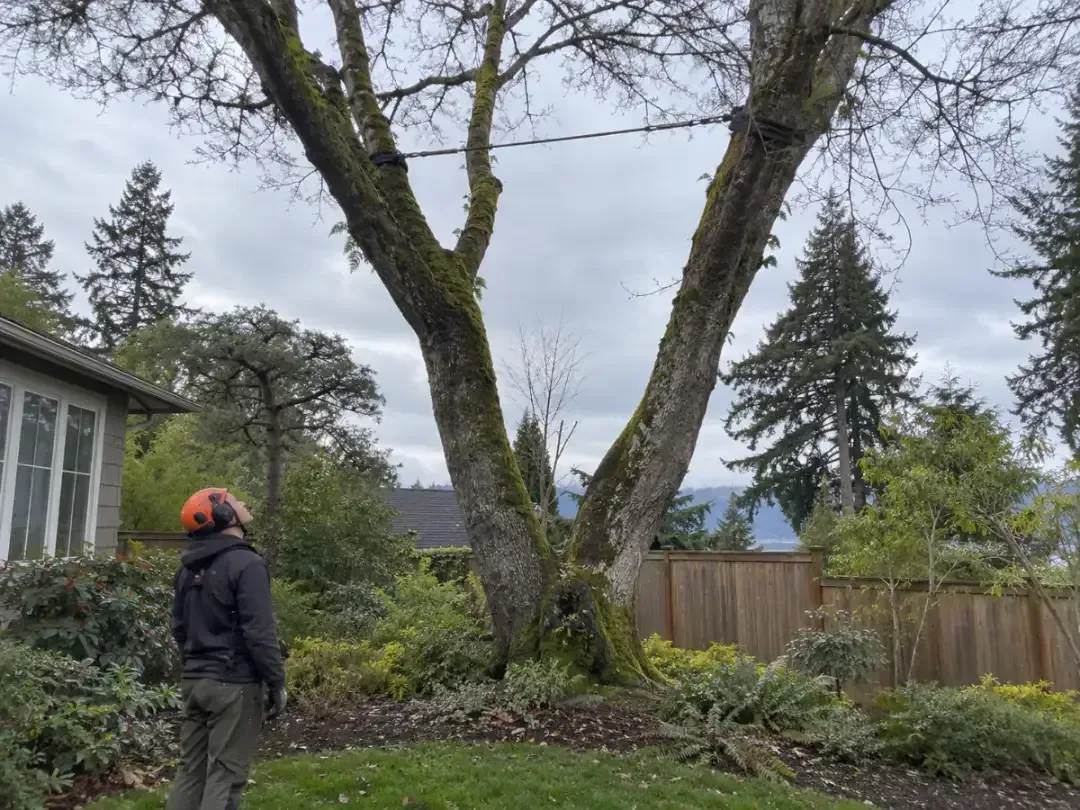
Some trees grow with two or more stems of roughly equal size rising from a shared point. That kind of structure can put stress on the union between stems, especially during wind, heavy rain, or snow load. A tree cabling service installs a high-strength cable between stems or major limbs to redistribute that load and reduce the risk of a stem splitting away from the tree. Pine & Ponder evaluates each tree on site before recommending cabling, because not every tree is a good fit for the work. Factors like stem diameter, the angle of the union, the overall health of the tree, and the proximity to structures or frequently used areas all play into the assessment. We will tell you honestly whether cabling makes sense or whether a different approach, such as pruning or removal, would serve the tree and your property better.
Why It Matters
Tree Stabilization Before a Problem Develops
Tree stabilization through cabling is most effective when it is installed before a structural problem becomes critical. If you have noticed a fork that looks like it is spreading, a stem that leans more than it used to, or bark that appears to be pulling apart at a union, those are reasonable reasons to request an evaluation. Cabling does not prevent tree failure outright, and we will not represent it that way. What it can do is reduce the mechanical stress on a weak union and give a tree that is otherwise healthy a better chance of staying intact. For property owners in Kitsap County who want to keep a valued tree rather than remove it, cabling is often the first conversation worth having.
Our Process
On-Site Evaluation First, Then a Clear Recommendation
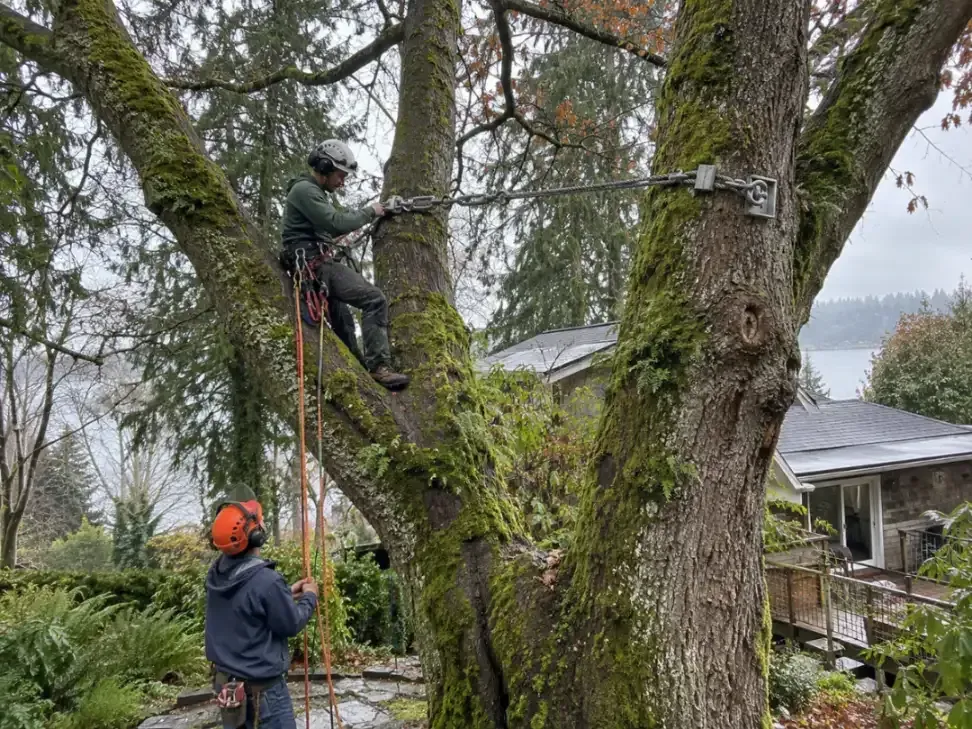
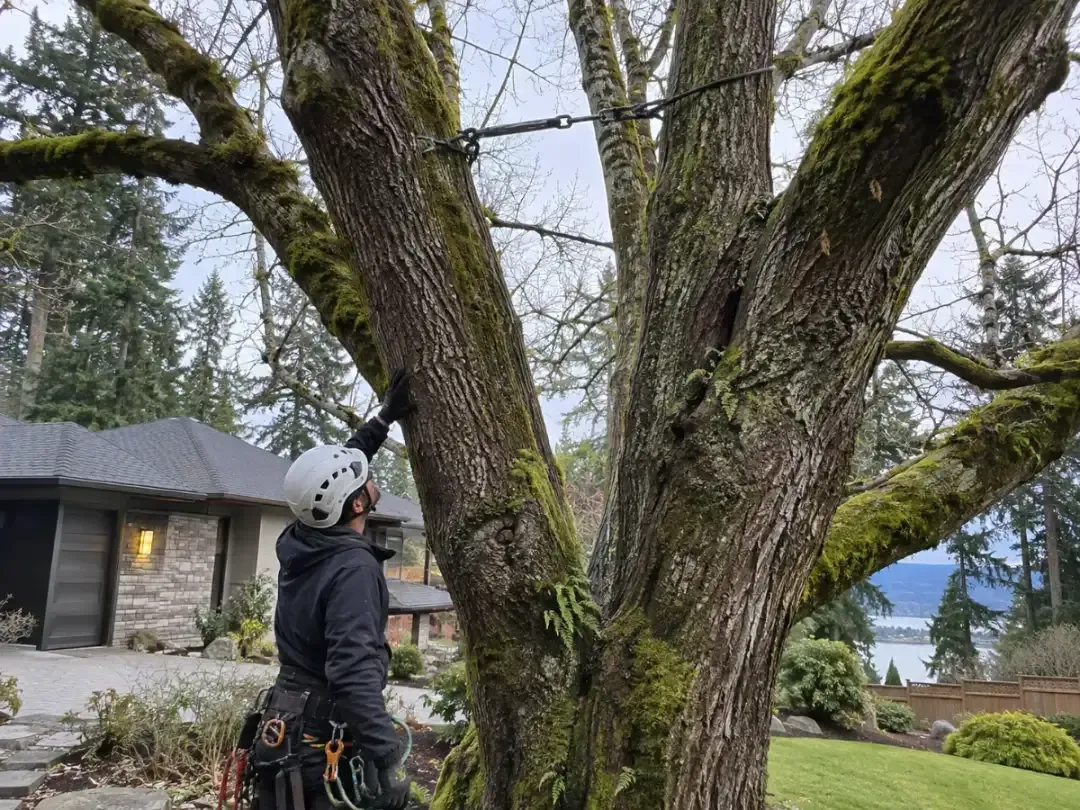
Every tree cabling project at Pine & Ponder starts with an on-site visit. Skyler, who performs much of the climbing work himself, looks at the tree's structure, the condition of the union or limb attachment, the surrounding site, and what the tree is near. From there, you get a straightforward recommendation: either cabling is a reasonable option and here is what it involves, or it is not the right fit and here is why. If cabling is appropriate, installation involves climbing to the correct position in the canopy and securing the cable at points that provide meaningful support without damaging the tree. The goal is careful, well-planned work that leaves the tree looking natural and your property in good order.
Good to Know
What to Expect from Support Cables for Trees
Support cables for trees are installed in the upper canopy, typically well above head height, so they are not especially visible from the ground once the work is done. The hardware used is designed for the purpose and sized to the tree. Cabling is not a permanent fix that requires no further attention. Trees grow and conditions change, so a cabled tree should be looked at periodically to confirm the installation is still appropriate. Pine & Ponder serves Bainbridge Island, Poulsbo, Kingston, Silverdale, Bremerton, and surrounding areas across Kitsap County. If you have a tree you are unsure about, reaching out for an on-site estimate is the best first step.
Common Questions
Tree Cabling FAQs
How do I know if my tree needs cabling?
The clearest signs are two or more stems of similar size growing from the same point, a fork where the bark appears to be pushing apart, or a stem that has started to lean noticeably. Other indicators include visible cracking near a branch union or a tree that has already partially split during a storm. None of these automatically mean cabling is the right answer, but they are good reasons to have someone look at the tree in person. An on-site evaluation is the only reliable way to determine whether cabling is appropriate for a specific tree.Does tree cabling guarantee the tree will never fail?
No, and we will not tell you otherwise. Cabling reduces the mechanical stress on a weak union and can lower the likelihood of a stem splitting away under load, but it does not make a tree failure-proof. Trees are living structures affected by weather, disease, root conditions, and factors that are not always visible from the outside. Cabling is most useful as a proactive measure on a tree that is otherwise in reasonable health. If a tree has significant internal decay or root damage, removal may be a safer option than cabling.What kinds of trees are good candidates for structural cabling?
Trees with codominant stems, meaning two or more trunks of similar diameter rising from a shared base, are the most common candidates. Multi-stem ornamental trees and certain fruit trees with wide, heavy limbs are also sometimes cabled. The tree generally needs to be in reasonably good health for cabling to make sense as a long-term investment. Trees with significant decay, major root problems, or a very advanced lean may be better candidates for removal. Skyler will give you a direct assessment during the on-site visit rather than recommending cabling when it is not the right fit.Will the cable be noticeable once the work is done?
Support cables are installed in the upper canopy, typically well above eye level, so they tend to be fairly unobtrusive once the work is done. The hardware is sized to the tree and positioned at points that provide structural benefit without being prominent from the ground. Most property owners find the installation much less visible than they expected. The goal is work that supports the tree without changing the way it looks from your yard or the street.Does a cabled tree need any follow-up attention?
Yes. Trees grow over time, and an installation that was correctly sized and positioned at the time of the work may need to be reviewed as the tree develops. It is a good idea to have a cabled tree looked at periodically to confirm the hardware is still appropriate and that the cable has not become embedded in the bark. How often that check is needed depends on the tree's growth rate and the specifics of the installation. We can give you a general sense of what to watch for after the work is complete.Can cabling be combined with pruning on the same tree?
Yes, and in many cases pruning and cabling work well together. Removing dead, broken, or excessively heavy limbs before or alongside cabling can reduce the load on a weak union and make the cabling more effective. Skyler will look at the whole tree during the on-site evaluation and let you know if a combination of services makes sense. The two types of work can often be completed in the same visit, which is more efficient for you and for the crew.Can you provide documentation for an insurance claim related to tree cabling?
Pine & Ponder can provide an invoice for completed work that you may choose to submit to your insurer. We do not guarantee that any insurer will approve or reimburse a claim, and we cannot predict how a specific policy will respond to a tree cabling service. If you are working with an insurance claim, it is worth contacting your provider directly to understand what documentation they require before we begin work.
What Customers Say